The salt that outlasted an empire
Our name comes from a king, a horse and a range of salt hills in the Punjab.
Some of this story is history. Some of it is legend. We think both are worth telling, so we tell them separately. You can decide which part you like best.
Part one: the history
A horse no one could ride
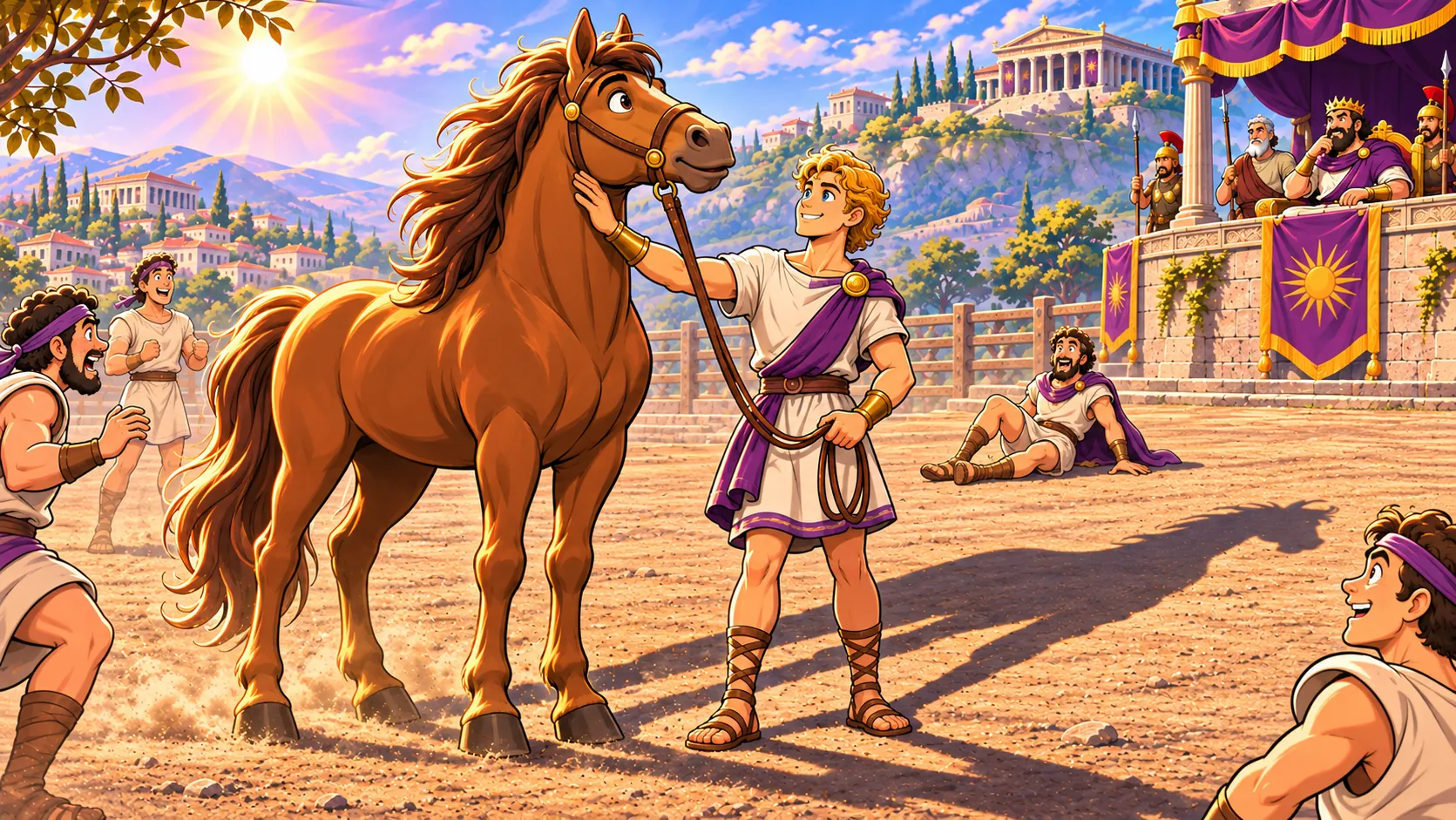
Around 344 BC, a horse dealer from Thessaly brought a big, dark horse to King Philip of Macedon. He asked thirteen talents for it, a huge price. The horse reared and kicked at everyone who came near. The king's riders gave up, and Philip told the dealer to take it away.
His son Alexander, about twelve years old, said they were losing a fine horse because nobody had the skill to handle it. He made a bet with his father. Then he walked up, took the bridle and turned the horse's head toward the sun.
He had noticed something the grown men had missed. The horse was afraid of its own shadow. With the sun ahead of him, the shadow fell behind, out of sight. The horse calmed. Alexander swung up and rode.
The horse was called Bucephalus, "ox-head". For the next eighteen years he carried Alexander into almost every great battle. The ancient writers say that, in his royal harness, he let no one else ride him.
The boy who wanted the edge of the map
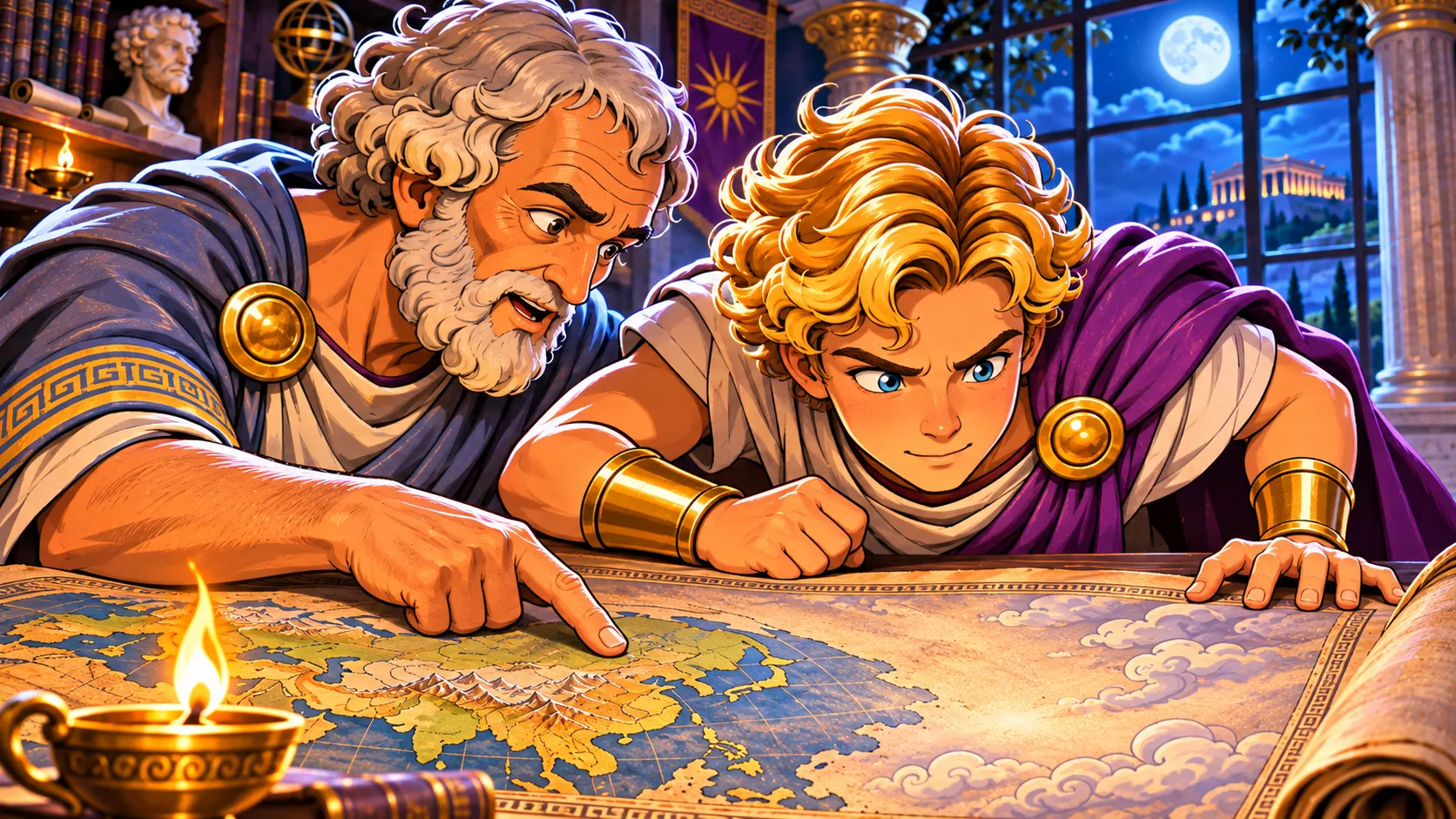
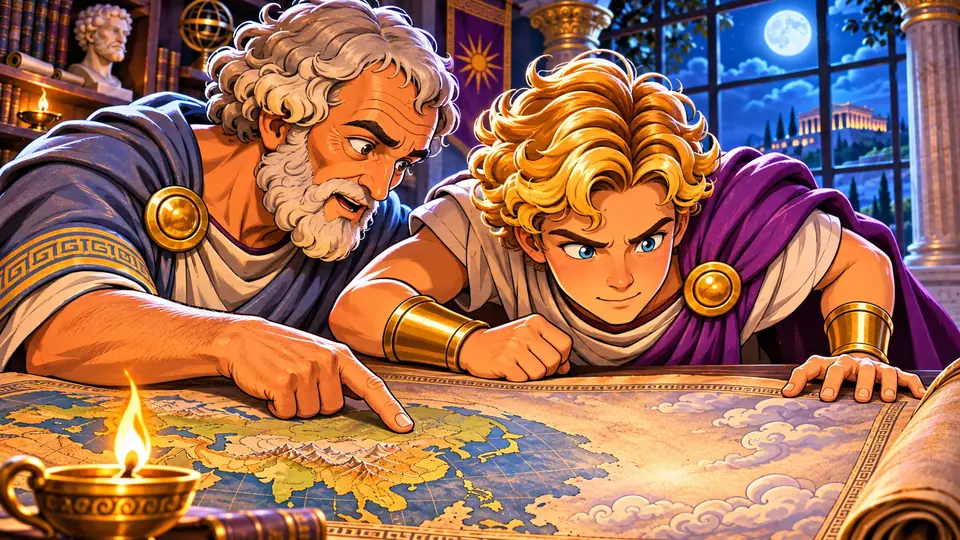
Alexander was taught by the philosopher Aristotle, at a quiet school among the trees at Mieza, from about the age of thirteen to sixteen. The world maps of the time ran out somewhere past Persia, at the edge of an imagined Ocean.
In 336 BC his father was murdered, and Alexander became king at twenty. Two years later, in the spring of 334 BC, he led an army of around forty thousand men out of Macedon and into Asia. He never came home.
Eight years east
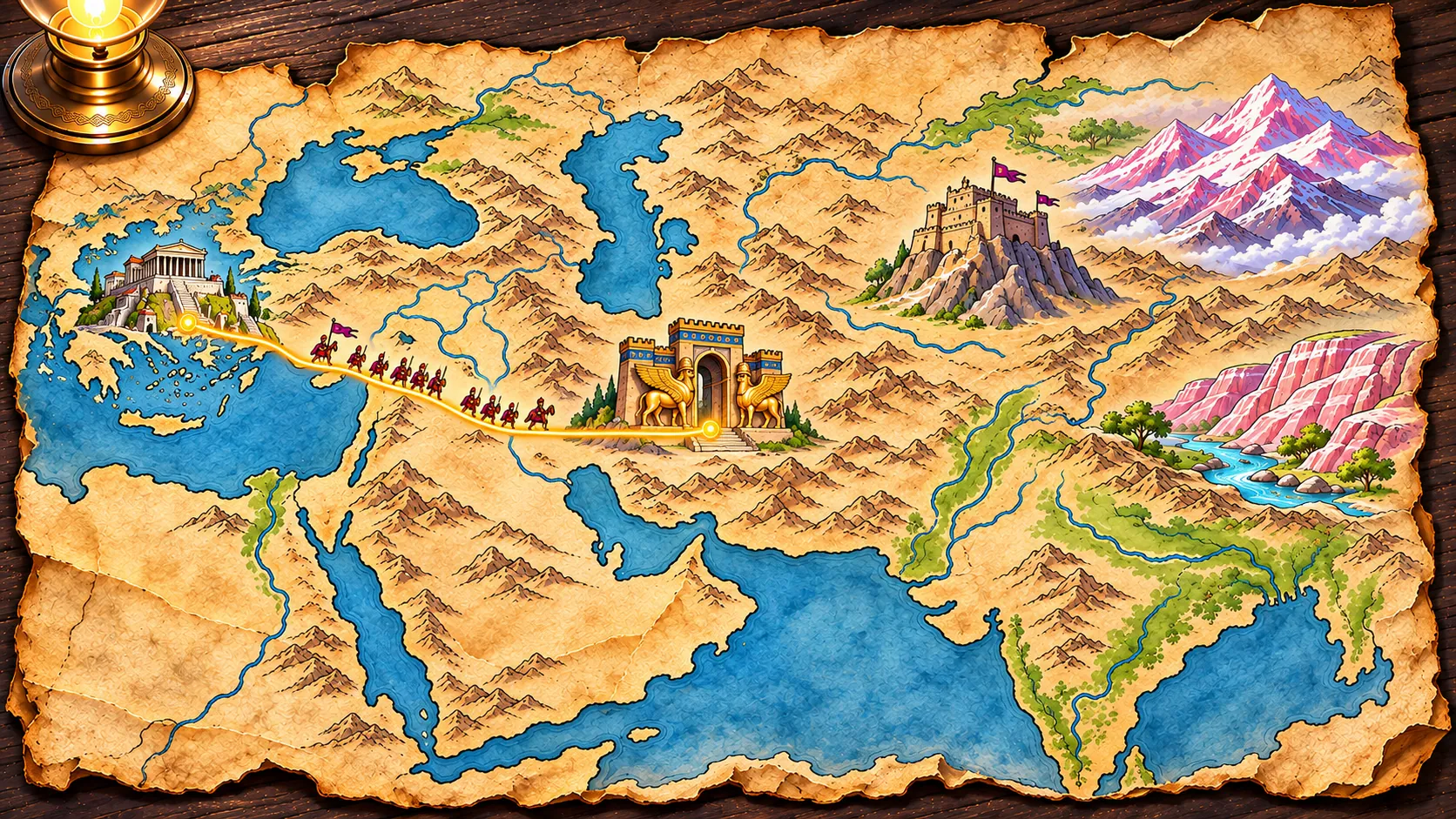
What followed is one of the most famous military campaigns in history.
At Gordium, in 333 BC, he was shown a knot that, people said, only the future ruler of Asia could undo. In the best-known version he cut it with his sword. Another ancient writer says he simply pulled out the pin it was tied around.
He marched down the coast, past Tyre and Gaza, and in late 332 BC Egypt opened its gates without a fight. He travelled into the desert to the oracle at Siwa, where he was greeted as a son of Zeus-Ammon. On the coast he marked out a new city with barley meal. It became Alexandria.
In 331 BC, at Gaugamela, he defeated the Persian king Darius. In 330 BC Persepolis fell and burned. In 327 BC, in the mountains of Sogdiana, three hundred of his men climbed a sheer cliff at night to take a fortress everyone thought could not be taken.
Then he crossed the Hindu Kush and the Indus, into the land of five rivers we now call the Punjab.
Spring 326 BC
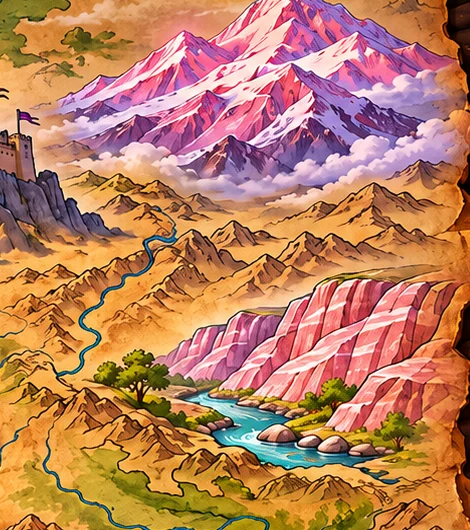
To reach the river Hydaspes, today the Jhelum, the army passed through a line of low, rust-and-rose hills that run along the river's northern bank. We call them the Salt Range.
At the Hydaspes, in May 326 BC, Alexander fought King Porus and his war elephants. It was a hard battle and a famous victory. It was also Bucephalus's last. He was about thirty years old, very old for a war horse, and he died soon after, from wounds or simply from age.
Alexander built a city on the river and named it Bucephala, after him. A long-held view places it near the modern town of Jalalpur, a short ride from the salt hills.
A few months later, further east at the river Beas, the army refused to go on. They were eight years and thousands of miles from home. Alexander gave in. He turned south, sailed down the rivers to the sea, and died in Babylon in 323 BC, aged thirty-two.
The empire he built broke apart within a generation.
Part two: the legend
The people who live in the Salt Range tell another story about that spring.
Legend has it that the army stopped to rest among the hills. The horses were tired from the long march, and some were sick. They began to lick the rocks, and would not stop.
A soldier was curious. He picked up a stone and touched it to his tongue. It was salt.
The story goes that the tired horses grew strong again. In our telling, the first horse to find the salt was Bucephalus. An old horse, at the end of a long road, who found one last treasure and led his king to it.
We can't prove that part. Nobody can. But it is the story people at Khewra have told for a very long time, and it is the reason our salt carries Alexander's name. You can follow the legend in full, told in eight illustrated chapters.
What happened next (history again)
Salt has almost certainly been dug from these hills for a very long time, but written records start later. The first recorded mining was by the local Janjua chiefs in the 13th century. In the Mughal era, salt from the Range was traded as far as Central Asia. In 1872 a British engineer laid out the mine at Khewra much as it stands today: long tunnels and great chambers, with half the salt left behind as pillars to hold up the mountain.
Khewra is now run by the Pakistan Mineral Development Corporation. It is often called the second-largest salt mine in the world. Miners still drill, blast and dig the salt, and much of the work, from loading to sorting, is still done by hand. Our page on how Khewra salt is mined and graded has the details.
The salt itself is far older than any of this. It was laid down when an ancient sea dried out, around 600 million years ago, long before there were horses, or kings, or mountains called the Himalaya.
Why we named it after Alexander
Alexander set out to take the whole world. He crossed deserts and rivers and mountains. His empire lasted a few years.
The salt is still here.
We like that. Alexander spent his short life taking things. Salt has always been something people pass around the table: a pinch on bread, a good meal shared with friends.
So that's our promise. We bring you salt from the same hills, at Khewra, picked and sorted with care, with nothing added. PLACEHOLDER: confirm source mine, sorting and no-additive claims with supplier before publishing.
From Khewra to your table.
A note on history and legend
The history on this page comes from the ancient writers Arrian and Plutarch, and from modern summaries of their work. Dates are BC and some are approximate. The discovery of the salt by Alexander's horses is a local legend. We tell it because we love it, and we say plainly that it is unproven.
Sources
- Arrian, The Anabasis of Alexander, and Plutarch, Life of Alexander: the ancient accounts of Bucephalus, the Hydaspes and the turn back at the Beas.
- Wikipedia: Bucephalus, Battle of the Hydaspes, Jalalpur Sharif (the likely site of Bucephala) and Khewra Salt Mine.
- Livius: the Battle of the Hydaspes, 326 BCE.