Ask almost anyone in Khewra how the salt was found and you'll hear the same story. Alexander the Great's army was resting in the hills. The horses were tired, some of them ill. They began licking the rocks and wouldn't stop. A soldier tried the rock himself and found it was salt.
It's a good story, and it's the reason our salt carries Alexander's name. It is also a legend. We think it's worth separating what the ancient writers tell us from what local tradition adds, because the true part is remarkable on its own.
The horse no one could ride
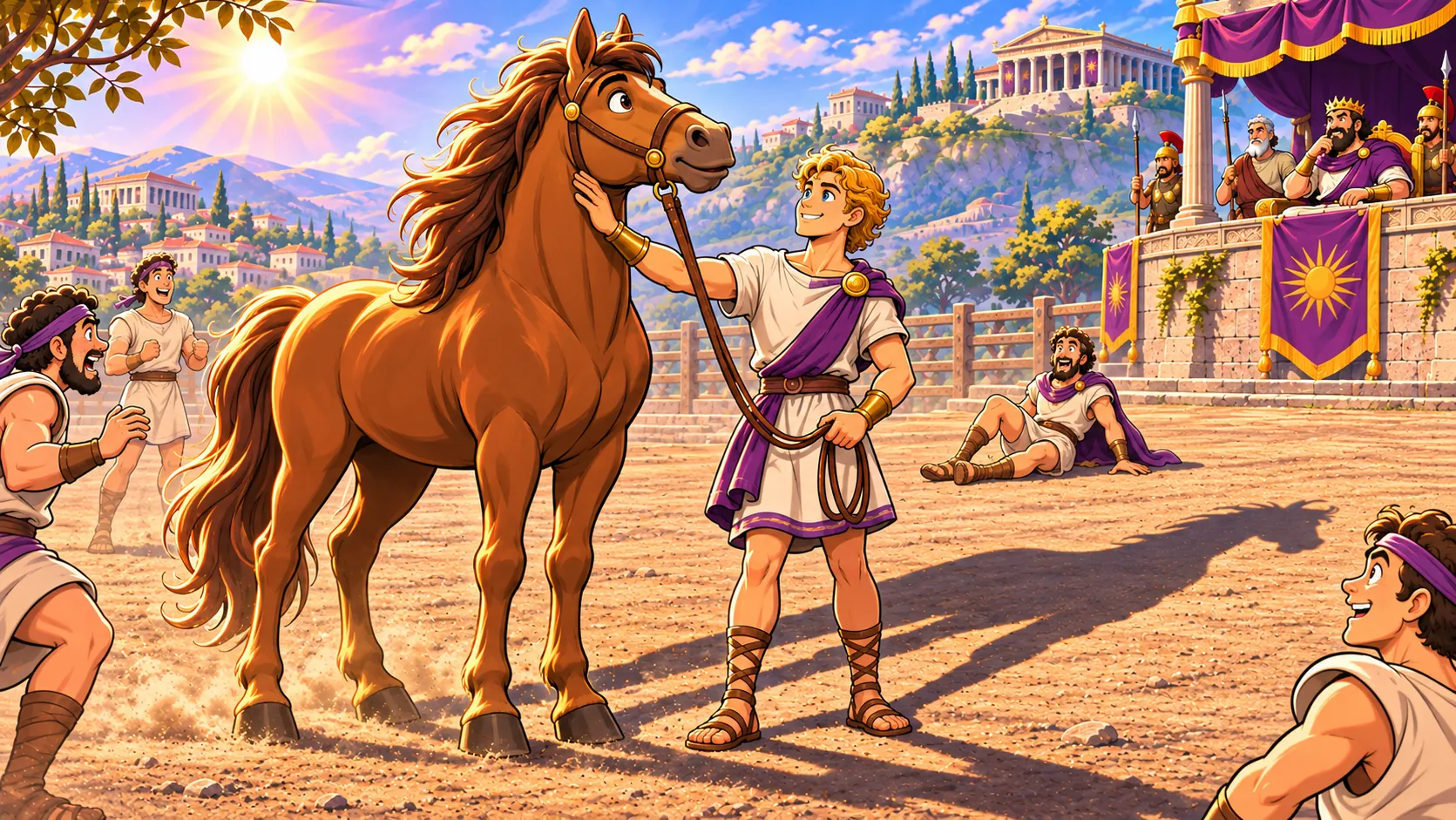
The best-known story about Bucephalus comes from the Greek writer Plutarch, who wrote it down more than four hundred years later. Around 344 BC a horse dealer from Thessaly brought a big, dark horse to King Philip II of Macedon and asked thirteen talents for it, a huge sum. The horse reared at everyone. Philip told the dealer to take it away.
His son Alexander, about twelve, said they were losing a fine horse for lack of nerve. He bet his father he could ride it. He had noticed that the horse shied at its own shadow, so he turned its head toward the sun, calmed it, and climbed on. Philip is supposed to have told him to find a kingdom big enough for himself, because Macedon would be too small.
The name Bucephalus means "ox-head", perhaps from a mark on his head or the shape of it. He carried Alexander for close to twenty years. You can read the full arc in Our Story, or watch it as the illustrated scroll film.
The road to the Punjab
In 334 BC Alexander crossed into Asia with an army of around forty thousand men. Over eight years he defeated the Persian king Darius, took Egypt, Babylon and Persepolis, and fought his way through what is now Afghanistan and Uzbekistan.
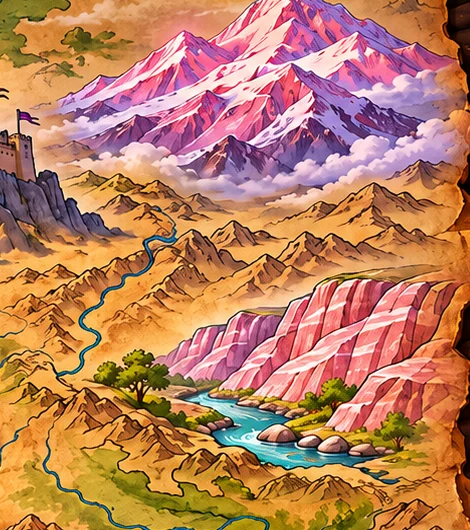
In the spring of 326 BC he crossed the Indus and was welcomed at Taxila, near modern Islamabad. To reach the next great river, the Hydaspes, which we now call the Jhelum, his army had to cross or skirt the Salt Range. Khewra sits in those hills, west of the river. So the setting of the legend is right. Alexander's army really did pass through this country, and its horses really would have needed salt.
The last battle
In May 326 BC, on the banks of the Jhelum, Alexander fought King Porus, whose army included war elephants. The Battle of the Hydaspes was one of his hardest victories.
It was also Bucephalus's last. He was about thirty, very old for a war horse. The ancient writers disagree on whether he died of wounds or simply of age, but they agree he died soon after the battle. Alexander founded a city on the river and named it Bucephala in his honour. Historians have long placed it near the modern town of Jalalpur Sharif, at the eastern end of the Salt Range, about 37 km from Khewra.
A few months later, further east at the Beas river, Alexander's tired army refused to march any further. He turned back, sailed down the rivers to the sea, and died in Babylon in 323 BC at thirty-two. He never saw Macedon again.
Where the legend comes in
None of the ancient historians who wrote about Alexander, Arrian, Plutarch, Curtius or Diodorus, mention his horses finding salt. The story lives in local tradition, and it is retold by the Punjab government's own Jhelum district pages, by guides at the mine, and on the Wikipedia page for Khewra, which describes it as a legend.
Legend has it that the army stopped to rest among these hills. The horses, worn out from the long march, began to lick the rocks. The soldiers saw that the horses that licked grew stronger. One of them tasted the stone and found it was salt. In our own telling, the first horse to find it was old Bucephalus, at the end of a very long road.
We can't prove that part. Nobody can. What we can say is that animals have always found salt licks, and that people living near an outcrop of pure rock salt would hardly have needed a Greek army to tell them about it. Salt was almost certainly being taken from these hills long before 326 BC.
What the record does show
The first written evidence for mining at Khewra comes from the 13th century, when the Janjua clan were working and trading the salt. Under the Mughals the trade grew. In 1872 the British laid out the mine much as it stands today. We tell that history in more detail in The Khewra Salt Mine: facts, history and what it is like inside.
The salt itself is far older than any of these people. It was laid down when an ancient sea dried out around 600 million years ago, which makes the arguments about who found it first seem small.
Why we still tell it
There are two kinds of honesty a brand can have about a story like this. One is to drop it because it can't be proved. The other is to tell it and say clearly what it is. We prefer the second. Stories like this one are how people have passed on the importance of a place for centuries, and the Khewra legend is a good one: an old horse, far from home, finding something precious in the hills.
So when you see "legend has it" on our website, that is exactly what we mean. The history is on one side, the story on the other, and you can enjoy both.