"Fake Himalayan salt" can mean several different things. It might be ordinary salt dyed pink. It might be genuine pink rock salt from somewhere other than the Salt Range. It might be real Himalayan salt with a made-up story on the label, or a pack that says nothing at all about where it came from.
Most pink salt on sale is real rock salt. But the word "Himalayan" sells, and it isn't a protected name everywhere, so a few minutes of checking is worth it. These are the checks we'd make ourselves.
Start with the label
Origin. Genuine Himalayan salt is mined in the Salt Range of Pakistan, at Khewra and at other mines along the same hills such as Warcha and Kalabagh. The label should say "Product of Pakistan" or "Made in Pakistan". A pack that says only "from the Himalayas", or gives a country with no salt mines in the range, deserves a question.
You might also see pink salt sold as Indian. Much of the pink salt sold in India is imported from Pakistan in bulk, and some of it is re-packed and exported again. That doesn't mean the salt is fake, but it does mean the label is not telling you where it was mined. Pakistan has been working for several years to register Himalayan salt as a geographical indication, which would protect the name for salt from its own Salt Range.
Ingredients. One ingredient: salt (or "Himalayan pink salt", or "rock salt"). If you see a colour, an E-number or "sodium nitrite", it's something else. Sodium nitrite means curing salt, which we explain in Pink Himalayan salt and pink curing salt are not the same thing.
Who made it. A company name, an address and a lot code or batch number. The lot code lets the packer trace your pack back to a batch, and it's a basic sign that somebody takes quality control seriously.
Look at the colour
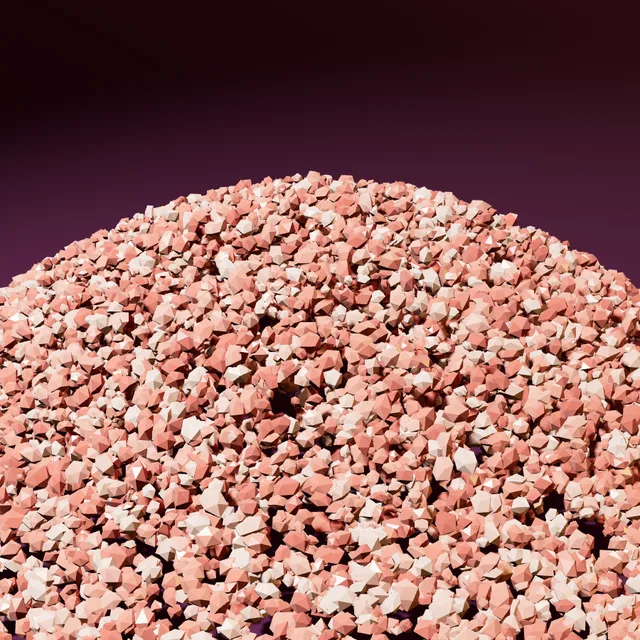
Natural pink salt is never one even colour. Coarse crystals show a mix of near-white, pale pink, salmon and darker red, and some grains are almost transparent. Fine grades look paler and more uniform, but still not flat.
A uniform, bright, candy-like pink, especially in a coarse grade, is the most common sign of dyed salt. We explain where the real colour comes from in Why is Himalayan salt pink?
Try the water test
Put a teaspoon of salt in a clear glass of water and stir until it dissolves.
- Real rock salt gives water that is clear or very slightly cloudy, with a little fine sediment settling at the bottom. That sediment is the trace of clay and minerals that were in the rock. The water itself shouldn't turn pink.
- Dyed salt often colours the water, sometimes strongly, and leaves the crystals paler.
This is a rough home check, not proof. It catches crude fakes and nothing else.
Taste and touch
Real pink salt tastes clean and salty, much like any other salt. A strong chemical, bitter or soapy taste is a warning. Natural crystals are hard, glassy and irregular; they don't feel waxy or leave colour on damp fingers.
A few very dark grains, or a little grit, can be normal in low-grade or loose market salt, where less sorting has been done. Large amounts of grit or dirt mean poor quality, real or not.
Ask for a lab report
The best evidence is a certificate of analysis from an independent lab. It shows the sodium chloride content, moisture, insoluble matter, and limits for heavy metals such as lead and arsenic. A serious producer will have one and should be willing to share it, with lot details if you're a trade buyer.
This matters because "natural" does not always mean "clean". In a 2020 study of 31 pink salts sold in Australia, one sample exceeded the Australian limit for lead. That sample came from Peru, not Pakistan, which is another reminder that "pink salt" and "Himalayan salt" are not the same thing. The rest were within limits. Testing is how you know.
Our own approach to testing, and what documents we can provide, is on our Quality and certifications page.
Claims that should make you wary
- Health promises. Pink salt does not detox, cure, balance hormones or improve sleep. A seller who says otherwise is not being careful with facts, and probably not with sourcing either.
- "84 minerals." Most of those are present only as faint traces. It's a marketing number.
- "Hand-mined from the Himalayas." The Salt Range is well south of the high Himalaya, and modern mining there uses drills and small blasts as well as hand work. A label that gets the geography wrong may have got other things wrong too.
- Prices far below everyone else's. Real rock salt is not expensive, but very cheap packs often cut corners on sorting, testing or honesty.
What a good pack looks like
A good pack of Himalayan salt tells you the country and, ideally, the mine. It lists one ingredient. It names the company that packed it and carries a lot code. The salt inside is uneven in colour. And the company is happy to answer questions.
That's the standard we set ourselves. Our salt comes from the Salt Range and is packed in our own factory under our own name. You can read more about where it comes from on The Salt, or, if you're curious about the mine itself, in The Khewra Salt Mine: facts, history and what it is like inside.
This article is for general information and isn't medical advice.